
From high-speed trains connecting cities to metros pulsing beneath them, modern rail and transit systems represent the pinnacle of engineered reliability. While the sweeping curves and sleek designs capture the public’s imagination, the true heart of these systems lies in an intricate ecosystem of precision-machined components. These parts, often unseen, are the fundamental guardians of safety, efficiency, and passenger comfort.
Every jolt-free acceleration, every smooth stop, and every safe journey at hundreds of kilometers per hour depends on the flawless performance of these critical components. This article explores the vital role of precision machining in the key systems of trains, metros, and rail infrastructure.
Part 1: The Bogie – The Foundation of Motion and Safety
The bogie (or truck) is the chassis beneath each rail vehicle, housing the wheels, axles, brakes, and suspension. It is the single most critical assembly for safety and performance, and a hub for precision-machined parts.
1. Axle Box Housings:
- Function: These housings connect the wheel axles to the bogie frame, containing the bearings that allow the wheels to rotate smoothly at high speeds.
- Precision Requirements: The bore for the bearing must be machined to extremely tight tolerances and superior surface finish. Any imperfection can lead to improper bearing fit, causing overheating, premature wear, or catastrophic bearing failure.
- Material & Manufacturing: Typically cast or forged from high-strength steel and finished via CNC machining to ensure dimensional accuracy and perfect geometric form.
2. Brake System Components:
- Function: Modern rail systems use sophisticated disc and regenerative braking systems.
- Key Machined Parts:
- Brake Discs/Hubs: Must be perfectly balanced and flat to prevent vibration (judder) during braking. They are machined from specialized iron or steel alloys capable of withstanding intense thermal stress.
- Brake Caliper Bodies: These are high-pressure hydraulic components. The internal bores and piston seats must be machined to leak-proof tolerances to maintain consistent braking force.
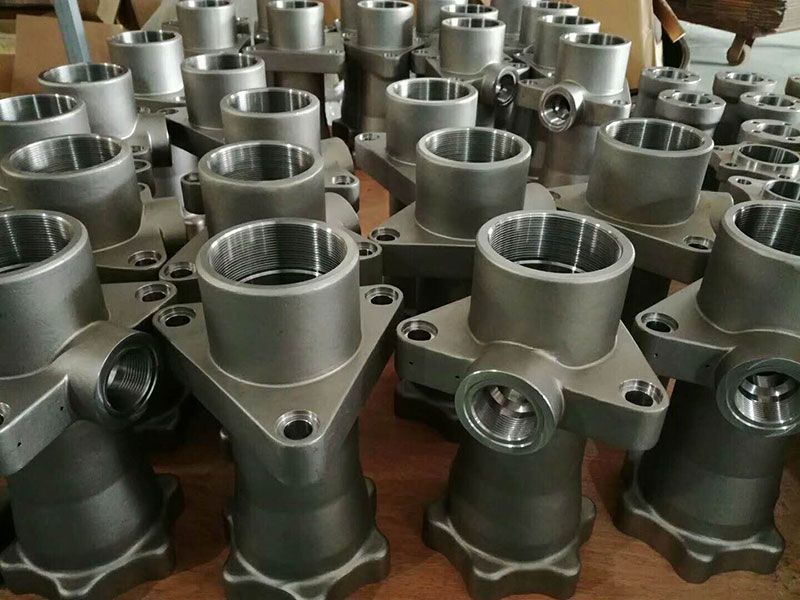
- Valve Bodies for Pneumatic/Electric Braking Systems: These control the precise flow of air or signals for graduated braking. Complex internal porting, machined with ultra-precision, ensures instantaneous and reliable response.
3. Suspension Components:
- Function: To absorb shocks from the track and ensure a smooth ride.
- Key Machined Parts:
- Air Spring Mounting Plates: Provide a precise, secure interface for the air springs that level the car.
- Damper (Shock Absorber) Connectors: The eyes and pins that connect dampers to the bogie frame are machined to precise geometries to ensure correct damping kinematics and avoid point loads that could lead to fatigue cracks.
Part 2: Propulsion and Drivetrain – The Heart of Performance
The system that converts electrical energy into motion relies on an orchestra of precision parts.
1. Traction Motor Components:
- Function: The electric motors that drive the axles.
- Key Machined Parts:
- Motor Housings & End Shields: These provide structural integrity and precise alignment for the stator and rotor. Cooling fins and internal passages are often machined to manage heat generated during operation.
- Motor Shafts: The rotor shaft is a critical component, requiring exceptional straightness (minimal runout), perfect bearing journals, and often a splined end for coupling to the gearbox. It is typically machined from high-strength alloy steel.
2. Gearbox Systems:
- Function: To reduce the high RPM of the traction motor to the lower RPM required by the wheels.
- Key Machined Parts:
- Gearbox Housings: These large, complex castings are machined on multiple axes to create precise bores for bearings and gears. The alignment of these bores is crucial for proper gear meshing and power transmission.
- Pinion and Bull Gears: These hardened steel gears are ground to micron-level accuracy after heat treatment to ensure quiet, efficient, and reliable power transfer under fluctuating loads.
3. Couplers and Draft Gears:
- Function: To connect rail cars and manage the compressive and tensile forces between them.
- Precision Requirements: The mating surfaces and internal mechanisms of automatic couplers are machined to ensure reliable connection and disconnection. The internal components of draft gears, which absorb impacts, require hardened and precisely finished surfaces to withstand millions of loading cycles.
Part 3: Passenger Comfort and System Integration
Beyond the core drivetrain, precision components are essential for the passenger experience and overall system function.
1. Door Systems:
- Function: For safe, reliable, and rapid passenger flow in metros and commuter trains.
- Key Machined Parts:
- Lead Screws and Actuator Components: These convert rotary motion to linear motion to open and close the heavy doors. The threads and nuts are machined for low backlash and smooth operation, with high wear resistance for millions of cycles.
- Door Guide Rails and Rollers: Precision-machined profiles ensure doors slide smoothly and align perfectly with the seals when closed, critical for safety and noise reduction.
2. Current Collection Systems (Pantographs):
- Function: To collect electricity from the overhead catenary wires.
- Key Machined Parts:
- Arms and Hinges: These components, often made from lightweight aluminum alloys, are machined to be strong yet light, allowing the pantograph to raise and lower quickly while maintaining consistent contact pressure with the wire.
- Air Cylinder Components: The pneumatic system that controls the pantograph’s pressure requires precisely machined cylinders and valves to function reliably.
3. HVAC Systems:
- Function: To provide climate control in passenger compartments.
- Key Machined Parts:
- Compressor Housings and Rotors: The heart of the cooling system relies on machined components that operate under high pressure and require perfect sealing.
- Air Distribution Manifolds: Complex ducting and manifold systems, often machined from aluminum, ensure even and efficient airflow throughout the train car.
Part 4: The Rigors of the Rail Environment – Material and Manufacturing Demands
Components for rail transit are not designed for a benign environment. They must endure a unique set of extreme conditions, which dictates strict requirements for materials and manufacturing processes.
- Vibration and Fatigue: Components are subject to constant, high-frequency vibrations. This demands designs and materials with high fatigue strength. Machining processes must avoid sharp corners and surface imperfections that can become initiation points for fatigue cracks.
- Extreme Loads: Parts must withstand massive static (crush) and dynamic (acceleration/braking) loads. High-strength low-alloy (HSLA) steels and ductile iron are common choices, machined to maintain their structural integrity.
- Environmental Exposure: Components are exposed to moisture, de-icing salts, and wide temperature swings. This makes corrosion-resistant materials like stainless steel (e.g., 316) and appropriate protective coatings (e.g., zinc-nickel plating, specialized paints) essential.
- Safety and Reliability: The ultimate priority is fail-safe operation. This is achieved through:
- Stringent Quality Control: Every critical component must be traceable and manufactured under a quality management system like IRIS (International Railway Industry Standard), the global standard for the rail sector.
- Non-Destructive Testing (NDT): Techniques like magnetic particle inspection, dye penetrant testing, and ultrasonic testing are routinely used on machined parts to detect subsurface or surface flaws invisible to the naked eye.
- Documentation: Complete documentation of material certifications, heat treatment records, and inspection reports (e.g., First Article Inspection) is mandatory for every batch of parts.
Conclusion: Engineering Trust, One Component at a Time
The seamless operation of a modern train is a testament to the precision and reliability of its thousands of machined components. From the robust bogie frames that guide it along the tracks to the intricate gears that propel it forward, each part plays a non-negotiable role in the system’s overall safety and performance.
For manufacturers and suppliers, succeeding in the rail industry means more than just making a part to a print. It requires a deep understanding of the operational environment, a commitment to the highest quality standards, and a partnership-based approach to overcome complex engineering challenges. It is about engineering trust, one precision component at a time, to keep the world moving safely and efficiently.